
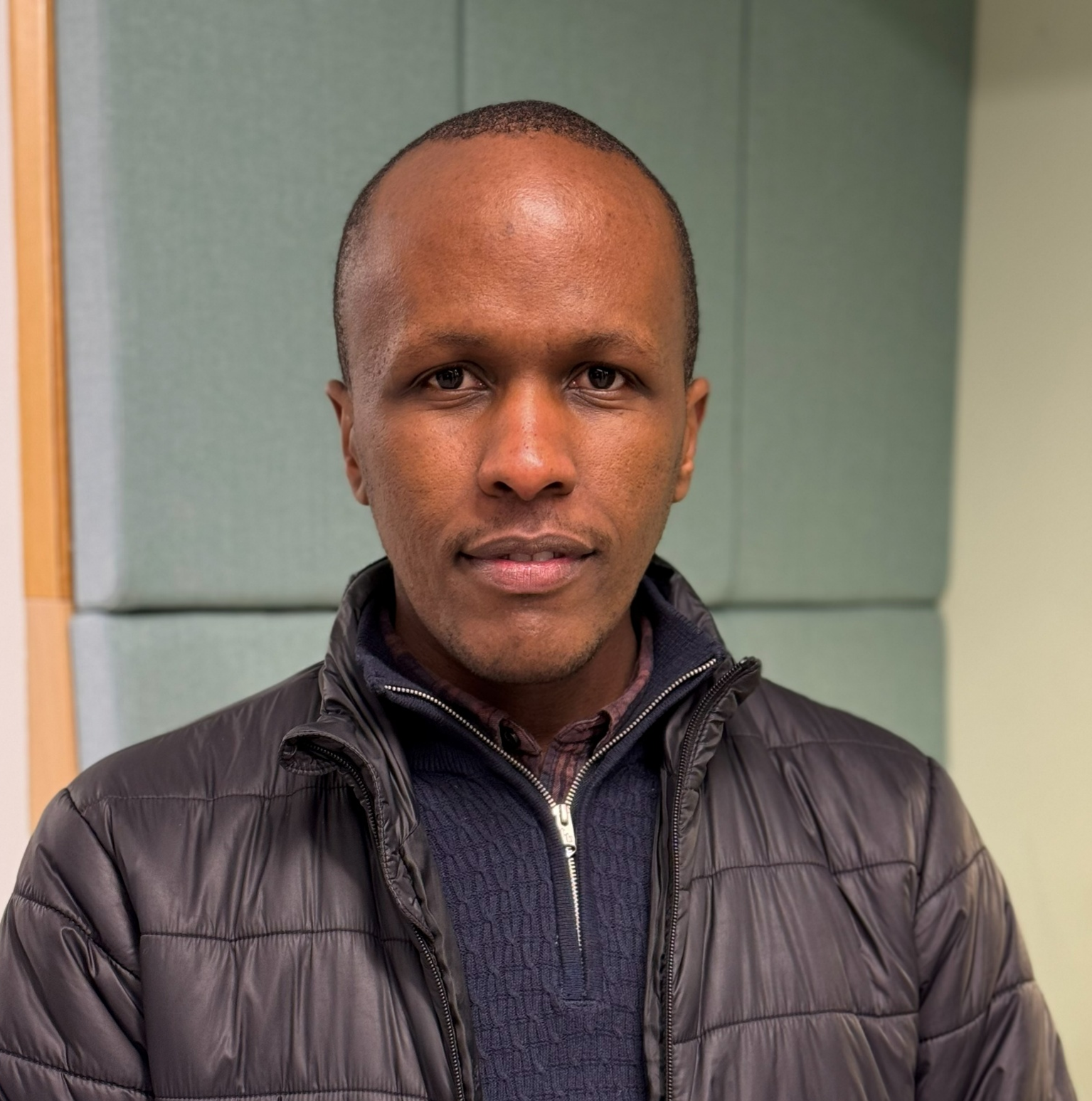
In February, Jameel postgraduate student John Mutua completed his PhD thesis on ‘Quantifying ruminant livestock diets in Tropical regions: Insights from Kenya.’
 Livestock are a major source of greenhouse gas (GHG) emissions, primarily through enteric fermentation, manure management, and nitrogen losses from grazing. Diet composition strongly influences feed quality, productivity, and methane emissions, yet existing data for tropical regions remain uncertain due to limited measurements and assumptions of constant diets throughout the year. Understanding spatial and seasonal variation in livestock diets is therefore essential for improving enteric methane estimates.
This thesis presents a new approach that uses freely available Earth observation (EO) proxies to generate spatially and temporally explicit estimates of livestock diet composition and quality. Kenya is used as the case study. The improved diet data are then applied to estimate enteric methane emissions from dairy cattle.
In the first analysis, Mutua used Monte Carlo simulations to evaluate how spatial and seasonal variations in diet composition influence diet quality and methane emissions for an adult female cow. Results show considerable deviation from Intergovernmental Panel on Climate Change (IPCC) default values. Dry matter digestibility (DMD) and methane emission factors varied both within and between production systems, with estimated emissions ranging from 37.1 to 72.8 kg CH₄ per head per year. These findings indicate a need for production‑system‑specific default values.
The second analysis developed seasonal livestock diet data using EO proxies of environmental, climatic, and socio‑economic conditions. Validation against field measurements from Meru County confirmed the approach’s accuracy. Mixed rainfed humid and temperate systems exhibited more diverse feed resources than mixed rainfed arid systems. Average DMD ranged between 56% and 61.1%, demonstrating clear spatial and temporal variation. The results highlight the feasibility of using EO data to cost‑effectively estimate livestock diet composition and quality.
The third analysis applied the EO‑derived diet data to estimate seasonal and annual methane emissions for dairy cattle. Estimated emissions totaled 10.6 million tonnes of CO₂‑equivalent across mixed production systems—lower than previous national estimates. Emissions varied widely by season, production system, and animal class (34.6 to 400.6 kg CO₂‑eq/head/season). Wet seasons and mixed rainfed temperate systems showed consistently higher emissions. These results improve the accuracy of Kenya’s emission inventories and enable more targeted mitigation strategies.
Overall, John’s thesis demonstrates that EO data can meaningfully enhance enteric methane assessments in data‑scarce regions. While EO products do not replace farm‑level data, they provide a scalable means to capture broad spatial and temporal patterns in livestock diets. The findings support more targeted mitigation efforts, improved life‑cycle assessments, and better‑informed livestock sector policies.
Download his thesis [embargoed until Januay 2027)
